Skip to content
Pittsburgh Foundation Repair Co.

Serving Pittsburgh and nearby areas

Sloping and Sagging Floors in Pittsburgh, PA

Floors that slope, dip or bounce mean something under them has moved or worn out, and a free inspection finds out whether it is the framing or the foundation.

Book a free foundation inspection

Tell us what you are seeing. A local specialist calls you back the same business day.

Local to Pittsburgh

We connect property owners in Pittsburgh and nearby areas, including Mount Washington, Polish Hill, Spring Hill, Lincoln Place, Bon Air and Lawrenceville, with one independent local foundation repair specialist.

What it costs

Typical published ranges for Pittsburgh. The contractor's written estimate is the price, and the inspection is free.

WorkTypical range
Inspection and written estimate Free
Sistering a joist $150 to $325per joist
Replacing a joist $500 to $2,500per joist
Replacing a main support beam $2,000 to $10,000
Sagging floor repair, typical whole job $1,000 to $8,500
Steel push pier, if the foundation has settled $1,000 to $3,000per pier
Structural engineer visit $250 to $500

See typical foundation repair prices in Pittsburgh

You set a marble on the kitchen floor and it rolls to the wall. Or the middle of the living room has a soft dip, and the china cabinet rattles when someone walks by. Sloping floors are one of the most common things people notice in older Pittsburgh homes. Some are old news. Some mean the house is still moving.

What you will notice

A ball or marble rolls

To one side of the room.

A dip in the middle

Of a room, often over a beam or a post in the basement.

A bouncy or soft feel

When you walk.

Gaps under baseboards

Or between the floor and the wall.

Doors that swing open or shut on their own,

Or will not latch.

Cracks in plaster or drywall,

Often at an angle from door and window corners.

Tile that cracks

Or wood floors that separate.

Kitchen cabinets or counters

Pulling away from the wall.

Why floors slope in Pittsburgh homes

Age. About half of the homes in the city were built before 1940. Wood beams and joists shrink, sag and creep over 100 years, especially where they carry heavy loads like a bathroom or a radiator.

Basement posts and beams. In many older houses, the main beam sits on posts or piers in the basement. A post that has rusted, rotted at the bottom, or sunk into a soft floor lets the middle of the house drop.

Water. Damp basements rot wood that touches stone or block walls. Rot at the ends of joists or on the sill plate on top of the wall lets the floor sink at the edges. Pittsburgh had its wettest year on record in 2018, and wet years are hard on old framing.

Old remodels. Joists notched or cut for pipes and ducts years ago can sag over time.

Foundation movement. If a corner of the foundation settles, every floor above it tilts the same way. On a hillside, a slope that is moving can do the same. The U.S. Geological Survey lists sticking doors and new cracks in walls and floors as signs of slope movement. The state lists unlevel windows and jammed doors as signs of mine subsidence.

Framing or foundation?

  1. A dip in the middle of the room with level edges usually points to the beam, posts or joists.
  2. The whole floor tilts toward one outside wall, and that wall has cracks in the foundation or brick, usually points to the foundation.
  3. The slope is getting worse month to month, or new cracks keep showing up. Something is still moving. That needs a closer look.

The inspection checks both: the framing in the basement and the foundation under it.

When it is minor and when it is urgent

Usually minor: an old, gentle slope that has not changed in years, with no new cracks. Many Pittsburgh houses have this. Keep an eye on it.

Call soon:

  • The slope is new or getting worse.
  • Doors start sticking that used to close fine.
  • Cracks show up in plaster, tile or brick.
  • A basement post is rusted, leaning or sitting on a broken base.

Urgent: a floor that sags suddenly, a beam that has cracked, a post that has kicked out, or floors and walls that tilt fast with cracking sounds. Keep weight off that area and call (412) 990-2570.

How sloping floors usually get fixed

New support posts

Adjustable steel posts on proper footings hold up a sagging beam. The floor is raised a little at a time.

Sistering joists

New lumber is bolted next to weak or cracked joists to stiffen them.

New beam

A rotted or cracked main beam is replaced.

Sill plate repair

Rotted wood on top of the foundation wall is cut out and replaced.

Piers

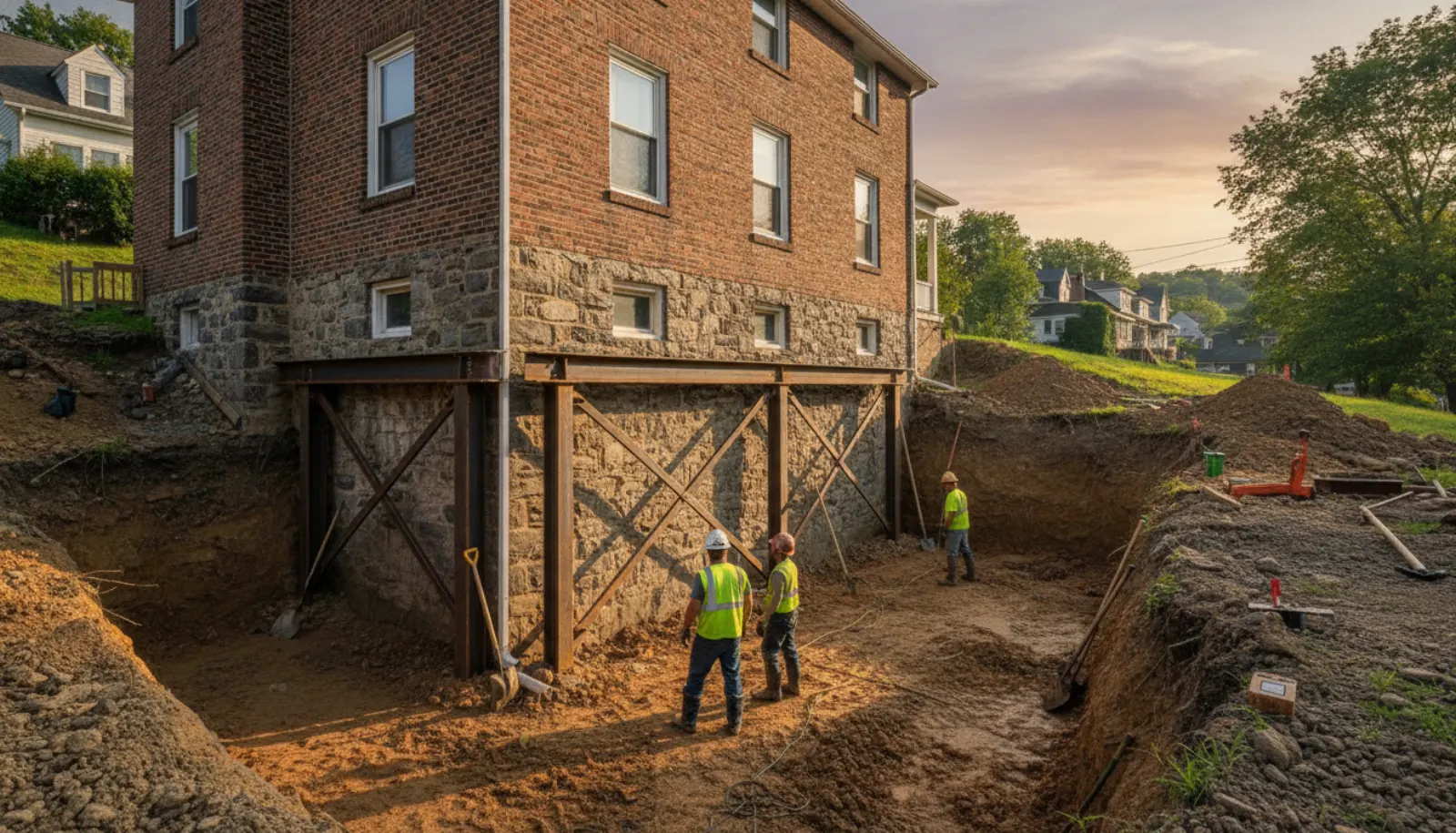
If the foundation itself has settled, steel or helical piers go under that part of the house to carry it to firm ground.

Drying the basement

If water caused the rot, drainage comes with the fix so it does not happen again.

What it costs

These are typical ranges from published cost guides, not quotes. Many jobs need only a few posts or joists. Bigger ones need a beam or piers.

What to do before the inspection

  1. Roll a marble in each room and note which way it goes.
  2. Use a level or a level app and write down the readings with the date.
  3. Look in the basement under the low spot for wet wood, rusty posts or cracked beams.
  4. Photograph cracks inside and out with a ruler for scale.
  5. Clear a path to the basement posts and beams so the inspector can see them.

Then call (412) 990-2570 or send the short form to book a free inspection with a local crew.

Frequently asked questions

Are sloping floors normal in an old house?

Some slope is common in a 100-year-old Pittsburgh house. Wood shrinks and settles over time. A slope that is getting worse, comes with new cracks, or makes doors stick should be checked.

How much floor slope is too much?

There is no single number for every house. A slope you can see, feel when you walk, or that is changing over time is worth an inspection. Write down what you measure so the inspector can compare.

Can sagging floors be fixed without lifting the whole house?

Often yes. Many sagging floors are fixed from the basement with new support posts, a stronger beam, or new wood bolted next to weak joists, called sistering.

Can a floor be made perfectly level again?

Not always. Old houses can crack if they are pushed too far, too fast. A careful crew lifts a little at a time and stops where the house says stop. Ask what lift to expect before work starts.

Is a bouncy floor a foundation problem?

Usually it is the framing, like joists that are too small, cut for old pipes, or damaged by rot or insects. If the floor also slopes toward one wall, the foundation may be part of it too.

(412) 990-2570 Free inspection